Look up home prices in University Heights and you'll find two numbers that cannot both be describing the same market. Through July 2025, Redfin's tracking showed the average sale price here at $675,000, up 28.6 percent from the year before. Over that same stretch, the median sale price fell 16.9 percent, landing at $345,000. One number says the market surged. The other says it cooled. Both are correct.
That contradiction isn't a data error, and it isn't noise you can average away. It's what happens when a housing market this small collides with a governance structure this unusual. University Heights covers roughly ten blocks and, as of the 2020 Census, counted 1,228 residents. It is also, despite sitting entirely inside Iowa City's borders, its own incorporated city, with its own government, its own police department, and its own line on your property tax bill. Understanding both of those facts, not just the sticker price, is what separates a buyer who reads the market correctly from one who reads a single headline number and walks away with the wrong story.
A Market Too Small to Average
Averages and medians tell you different things, and normally the gap between them is small enough to ignore. In a market the size of Iowa City, hundreds of homes trade every quarter, so one unusually expensive sale barely nudges either number. University Heights doesn't have that cushion. With roughly 1,200 residents spread across ten blocks, a handful of closings in any given month makes up the entire dataset. One high-end condo sale can pull the average sharply upward while three ordinary resales hold the median steady, or drag it down, in the same reporting window. That's the mechanical explanation for a 28.6 percent average gain sitting next to a 16.9 percent median decline in the same twelve months. It isn't two markets disagreeing. It's one very small market where the average and the median are measuring different things by design.
Two Housing Stocks From Different Eras
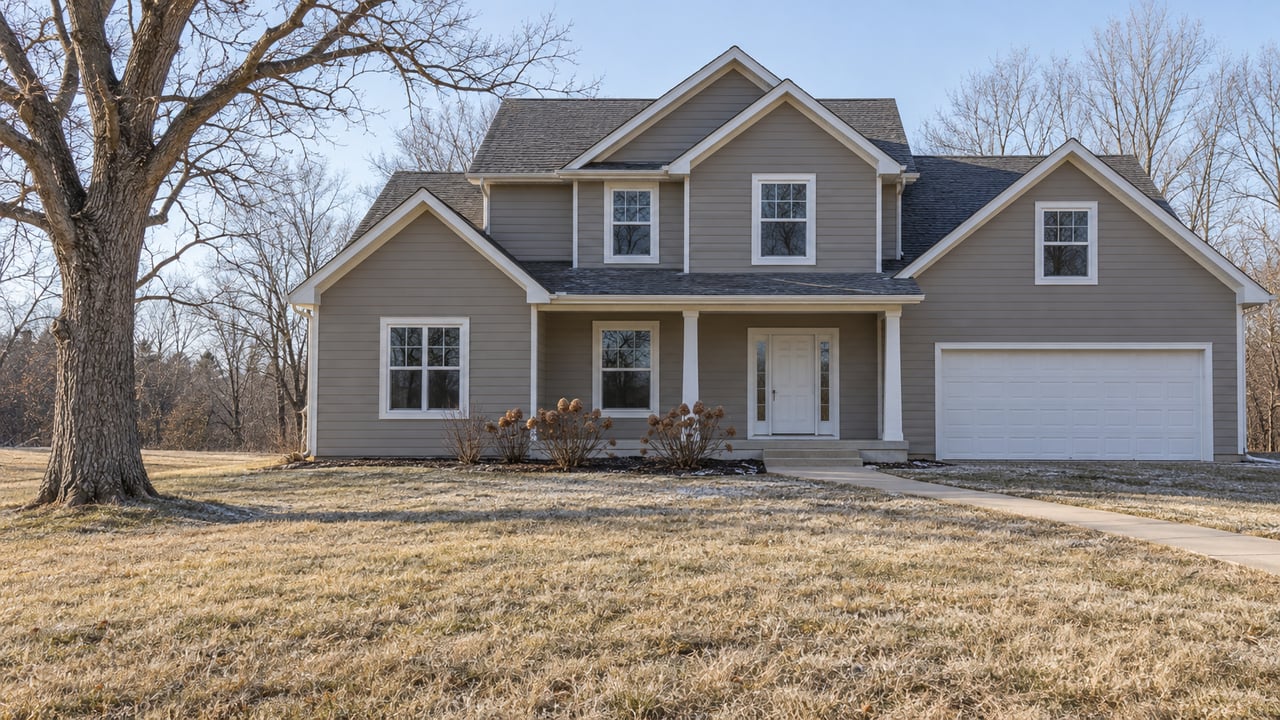
The reason that small sample splits so unevenly comes down to what actually sits on these ten blocks. University Heights exists because two brothers, George and Lee Koser, working as real estate agents in the 1920s, bought up land west of the University of Iowa on a bet that campus growth would eventually reach it. They were right. The interior streets filled in over the following decades with the ranch homes, split-foyers, and cottages that still define most of the housing stock today.
Then, in 2017 and 2018, that pattern broke. Developers delivered five-story luxury condominium buildings near Melrose Avenue, a genuinely different housing product landing inside the same small boundary as the prewar cottages a few streets over. From a market-statistics standpoint, that's the whole story. When a condo unit from the newer buildings closes, it pulls the average toward the high end of the range. When two or three of the older single-family homes trade in the same window, the median reflects that instead. Neither number is wrong. They're just describing different halves of the same ten blocks.
Timing adds another layer. University Heights sits close enough to the University of Iowa Hospitals and Clinics that its resale patterns track the academic calendar as much as the broader housing cycle. Incoming medical residents and fellows arrive on a yearly rhythm ahead of the fall semester, and that turnover shapes which segment of the local stock is actually changing hands in a given month. A buyer comparing "spring in University Heights" to "spring in a neighboring Iowa City pocket" may be comparing two different kinds of inventory without realizing it.
A City Inside a City
The price mechanics are only half of what makes this pocket behave differently from its surroundings. University Heights isn't a subdivision name or a marketing label for part of Iowa City. It's a separate incorporated municipality, with its own mayor-council government and its own police department, University Heights PD, answering its own dispatch line rather than Iowa City's.
That separation shows up directly on a buyer's tax bill. Johnson County's fiscal year 2024 levy breakdown shows exactly how the consolidated rate splits for a University Heights property:
| Taxing authority | Rate per $1,000 valuation | Share of consolidated bill |
|---|---|---|
| Iowa City Community School District | $16.26830 | 45% |
| Johnson County | $6.06180 | 17% |
| City of University Heights | $11.78755 | 32% |
| Other | $2.29160 | 6% |
Nearly a third of the bill funds a city government that exists only within these ten blocks. That's not an abstraction. In recent months, the city has run its own sidewalk repair program, marking panels with pink paint to flag safety issues and arranging a contractor to handle repairs on behalf of property owners, and its council heard a presentation on a Multi-Use Trail Master Plan for the community. University Heights even sets its own fireworks rules, distinct from Iowa City's, with specific hours permitted around July 4th and New Year's. None of that governs a property three blocks away with an Iowa City address, because a different government isn't making those calls there.
Kids in University Heights still attend Iowa City Community School District schools, which is exactly why the school levy line dominates the tax bill even though the city itself is separate. Buyers get the district they expect and a municipal government they may not, layered on top of it.
What This Means If You're Comparing Neighborhoods
If you're weighing University Heights against another close-in Iowa City pocket, the average or median price on a portal search is the least useful number in the comparison. Ask instead what actually sold to produce it. A condo closing near Melrose and a cottage resale a few streets over are not the same transaction, and treating them as interchangeable data points will distort your sense of what a typical purchase here actually looks like.
Budget for the full levy stack, not just the county-wide average. A University Heights property carries its own city rate on top of the school and county levies that any Iowa City-area buyer already expects. That 32 percent share funds real, active services: its own police response, its own infrastructure decisions, its own council meetings held regularly at the community center on Melrose Avenue.
And if timing matters to your search, keep the academic calendar in mind. Turnover tied to incoming medical residents and fellows tends to cluster ahead of the fall semester, which can shift what's available and when far more than it would in a larger, less specialized market.
A Few Common Questions
Is University Heights part of Iowa City? No. It sits entirely inside Iowa City's borders but operates as its own incorporated city, with a separate government and police department. The confusion is understandable given the address, but the governance is genuinely distinct.
Why do listings show such a wide price range? Because the ten blocks contain two different housing products from two different eras: single-family homes dating to the neighborhood's original 1920s development, and luxury condominium buildings completed in 2017 and 2018. A wide range reflects two housing types within one market.
Does University Heights have its own property tax bill? Its own levy, yes, which appears alongside the county and school district rates on the same consolidated statement a buyer receives at closing.
Reading a market like this takes more than a single stat pulled from a search bar. It takes knowing what's actually sitting behind the number, which is the kind of interpretive work worth doing before you fall for either headline. If you're comparing University Heights against another neighborhood on your list and want someone to walk through what the numbers are actually telling you, Opal & Oak Real Estate would be glad to sit down and look at it together. Schedule a Curated Listing Consultation whenever you're ready to talk specifics.
This article is general information, not legal, tax or financial advice. Consult a qualified professional about your situation.